Once there was a mother who had three daughters. The eldest was rough and unkind, the middle one a little better though not without faults, and the youngest was quiet and good. But the mother had a strange nature—she loved the eldest the most and could not stand the youngest.
She often sent the youngest deep into the forest, hoping she would get lost and never return. Each time, however, the girl relied on her wits and her luck and somehow found her way home.
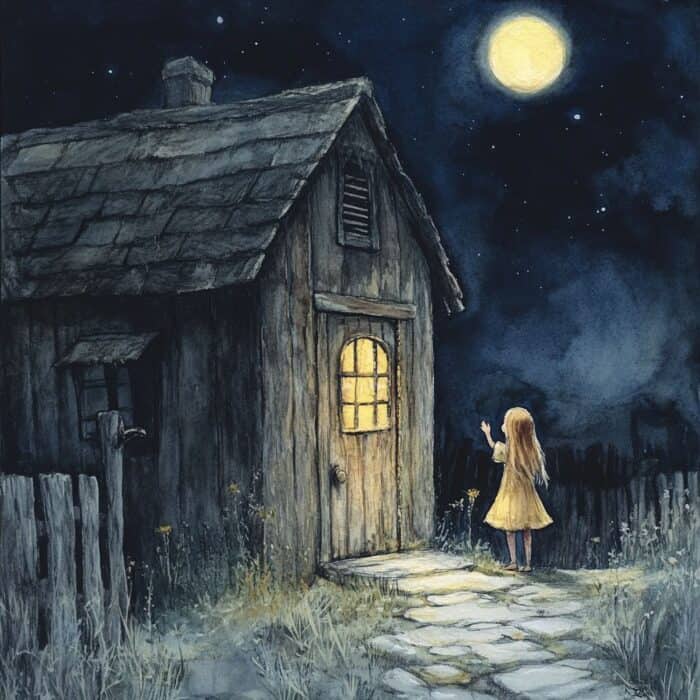
One day dusk fell earlier than she expected, and she lost her way among the spruces. She walked and walked until, in the distance, she spotted a faint light. She ran toward it and came to a small wooden cottage. She knocked; the door gave a little. When she knocked a second time, an old man with a long snow-white beard and gentle eyes opened to her.
“Come in, child,” he said kindly. “I am Saint Joseph. You can warm yourself by the fire. I have water from the spring, but to eat there’s nothing more than a few roots—they must be scraped and boiled.”
He handed her a bundle of roots. The girl carefully cleaned them, added a piece of pancake and some bread her mother had given her, boiled everything together, and made a thick soup. When it was ready, Joseph said, “I’m so hungry—might I have a bit?” The girl smiled and offered him more than she kept for herself.
After supper he said, “I have only one bed. You lie in it; I’ll make myself a place on the straw.”
The girl shook her head. “You stay in the bed, Joseph. The straw is soft enough for me.” She wrapped herself in a blanket by the fire and fell asleep.
In the morning she wanted to greet Joseph, but she couldn’t find him. Only a heavy purse of coins lay by the door with a note: for the child who slept here. She took the purse and ran home. She gave it to her mother, who was so pleased that she praised her for the first time.
The next day the middle daughter set out for the forest. Their mother gave her a larger piece of pancake and more bread. She traveled until she reached the same cottage. Joseph gave her roots, and when the soup was done, he asked, “I’m hungry—give me something from yours.” The girl said, “You may have your share,” and she divided it as she felt was fair. When he offered her the bed and said he would lie on the straw, she replied, “Lie in the bed; we’ll both fit.” Joseph left the bed to her and lay on the straw himself. In the morning he was gone, but a smaller purse of coins waited by the door. The girl secretly kept two pieces for herself and brought the rest to her mother.
On the third day the eldest daughter decided to go as well. Their mother packed her as many pancakes as she wanted, and added bread and cheese besides. The girl found the cottage without much wandering. She made the soup, but when Joseph said, “I’m hungry—please, give me a little from yours,” she snapped, “Wait until I’ve eaten. If anything is left, you can have it.” She ate nearly everything, and Joseph had to scrape what remained from the bottom.
When he offered her the bed, she took it without a second thought and left the old man on the straw. In the morning Joseph was gone. The girl looked for a purse of money, but on the floor she spotted something shiny. She bent to pick it up—and at that instant a second nose settled onto her own, fastened tight to the first. She shrieked and ran out of the cottage, and among the spruces she ran right into Joseph. She fell at his feet and begged him with all her heart. He took pity, removed the second nose, and handed her two pennies—so that next time, he said, she would know how to share.
When she got home, their mother asked, “What did you get?” The girl lied, “A great purse of money, but I lost it on the way.” “Lost it?” cried the mother. “We’ll find it!” She grabbed her by the hand and they set off back into the forest. But a thick fog rose, the paths tangled around them, and they wandered so long that no one ever found them. The forest grew quiet again, and the wind played in the needles as if nothing had happened.