Hans wished to put his son to learn a trade, so he went into the church and prayed to our Lord God to know which would be most advantageous for him. Then the clerk got behind the altar, and said, “Thieving, thieving.” On this Hans goes back to his son, and tells him he is to learn thieving, and that the Lord God had said so. So he goes with his son to seek a man who is acquainted with thieving. They walk a long time and come into a great forest, where stands a little house with an old woman in it. Hans says, “Do you know of a man who is acquainted with thieving?” – “You can learn that here quite well,” says the woman, “my son is a master of it.” So he speaks with the son, and asks if he knows thieving really well? The master-thief says, “I will teach him well. Come back when a year is over, and then if you recognize your son, I will take no payment at all for teaching him; but if you don’t know him, you must give me two hundred thalers.”
The father goes home again, and the son learns witchcraft and thieving, thoroughly. When the year is out, the father is full of anxiety to know how he is to contrive to recognize his son. As he is thus going about in his trouble, he meets a little dwarf, who says, “Man, what ails you, that you are always in such trouble?”
Traditional fairy tales
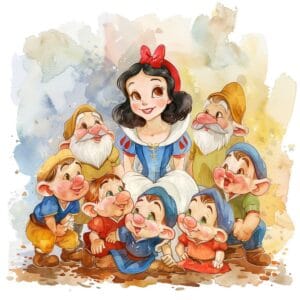
Traditional fairy tales, these are beautiful tales that have been loved by children and their parents for hundreds of years. Perhaps the language has been dusted off a little, but Hansel always steals the gingerbread and Snow White always gets a kiss from the prince. A good ending is also traditional in fairy tales!
King Thrushbeard
A King had a daughter who was beautiful beyond all measure, but so proud and haughty withal that no suitor was good enough for her. She sent away one after the other, and ridiculed them as well.
Once the King made a great feast and invited thereto, from far and near, all the young men likely to marry. They were all marshalled in a row according to their rank and standing; first came the kings, then the grand-dukes, then the princes, the earls, the barons, and the gentry. Then the King’s daughter was led through the ranks, but to every one she had some objection to make; one was too fat, “The wine-cask,” she said. Another was too tall, “Long and thin has little in.” The third was too short, “Short and thick is never quick.” The fourth was too pale, “As pale as death.” The fifth too red, “A fighting-cock.” The sixth was not straight enough, “A green log dried behind the stove.”
The Wishing-Table, the Gold-Ass, and the Cudgel in the Sack
There was once upon a time a tailor who had three sons, and only one goat. But as the goat supported the whole of them with her milk, she was obliged to have good food, and to be taken every day to pasture. The sons, therefore, did this, in turn. Once the eldest took her to the churchyard, where the finest herbs were to be found, and let her eat and run about there. At night when it was time to go home he asked, “Goat, hast thou had enough?” The goat answered,
“I have eaten so much,“Come home, then,” said the youth, and took hold of the cord round her neck, led her into the stable and tied her up securely. “Well,” said the old tailor, “has the goat had as much food as she ought?” – “Oh,” answered the son, “she has eaten so much, not a leaf more she’ll touch.” But the father wished to satisfy himself, and went down to the stable, stroked the dear animal and asked, “Goat, art thou satisfied?” The goat answered,
Not a leaf more I’ll touch, meh! meh!”
“Wherewithal should I be satisfied?“What do I hear?” cried the tailor, and ran upstairs and said to the youth, “Hollo, thou liar: thou saidest the goat had had enough, and hast let her hunger!” and in his anger he took the yard-measure from the wall, and drove him out with blows.Continue reading
Among the graves I leapt about,
And found no food, so went without, meh! meh!”
The fisherman and his wife
There was once a fisherman and his wife who lived together in a hovel by the sea-shore, and the fisherman went out every day with his hook and line to catch fish, and he angled and angled.
Continue readingLuck may lie in a pin
A Story Told For My Young American Friends
Continue readingThe toad
The well was deep, and therefore the rope had to be a long one; it was heavy work turning the handle when any one had to raise a bucketful of water over the edge of the well. Though the water was clear, the sun never looked down far enough into the well to mirror itself in the waters; but as far as its beams could reach, green things grew forth between the stones in the sides of the well.
Continue readingThe metal pig
In the city of Florence, not far from the Piazza del Granduca, runs a little street called Porta Rosa. In this street, just in front of the market-place where vegetables are sold, stands a pig, made of brass and curiously formed. The bright color has been changed by age to dark green; but clear, fresh water pours from the snout, which shines as if it had been polished, and so indeed it has, for hundreds of poor people and children seize it in their hands as they place their mouths close to the mouth of the animal, to drink. It is quite a picture to see a half-naked boy clasping the well-formed creature by the head, as he presses his rosy lips against its jaws.
Continue readingA story from the sand dunes
This is a story of the sand dunes of Jutland, but it doesn’t begin there; no, it begins far away to the south, in Spain. The ocean is the highway between the two countries. So now let your thoughts journey to Spain!
Continue readingThe old bachelor’s nightcap
There is a street in Copenhagen with a very strange name. It is called “Hysken” street. Where the name came from, and what it means is very uncertain. It is said to be German, but that is unjust to the Germans, for it would then be called “Hauschen,” not “Hysken.” – “Hauschen,” means a little house; and for many years it consisted only of a few small houses, which were scarcely larger than the wooden booths we see in the market-places at fair time.
Continue readingUnder the willow tree
The country around the town of Kjöge is very bare. The town itself lies by the seashore, which is always beautiful, although it might be more beautiful than it is, because all around are flat fields, and a forest a long way off. But one always finds something beautiful in the spot that is one’s own home, something for which one longs, even when one is in the most wonderful spot in the world.
Continue reading