A father once called his three sons before him, and he gave to the first a cock, to the second a scythe, and to the third a cat. “I am already aged,” said he, “my death is nigh, and I have wished to take thought for you before my end; money I have not, and what I now give you seems of little worth, but all depends on your making a sensible use of it. Only seek out a country where such things are still unknown, and your fortune is made.”
After the father’s death the eldest went away with his cock, but wherever he came the cock was already known; in the towns he saw him from a long distance, sitting upon the steeples and turning round with the wind, and in the villages he heard more than one crowing; no one would show any wonder at the creature, so that it did not look as if he would make his fortune by it.
Traditional fairy tales
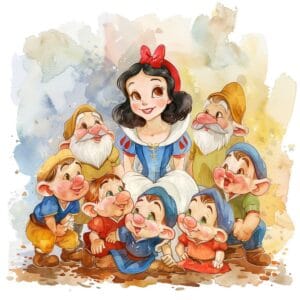
Traditional fairy tales, these are beautiful tales that have been loved by children and their parents for hundreds of years. Perhaps the language has been dusted off a little, but Hansel always steals the gingerbread and Snow White always gets a kiss from the prince. A good ending is also traditional in fairy tales!
The knapsack, the hat, and the horn
There were once three brothers who had fallen deeper and deeper into poverty, and at last their need was so great that they had to endure hunger, and had nothing to eat or drink. Then said they, “We cannot go on thus, we had better go into the world and seek our fortune.” They therefore set out, and had already walked over many a long road and many a blade of grass, but had not yet met with good luck. One day they arrived in a great forest, and in the midst of it was a hill, and when they came nearer they saw that the hill was all silver. Then spoke the eldest, “Now I have found the good luck I wished for, and I desire nothing more.” He took as much of the silver as he could possibly carry, and then turned back and went home again. But the two others said, “We want something more from good luck than mere silver,” and did not touch it, but went onwards. After they had walked for two days longer without stopping, they came to a hill which was all gold. The second brother stopped, took thought with himself, and was undecided. “What shall I do?” said he; “shall I take for myself so much of this gold, that I have sufficient for all the rest of my life, or shall I go farther?” At length he made a decision, and putting as much into his pockets as would go in, said farewell to his brother, and went home. But the third said, “Silver and gold do not move me, I will not renounce my chance of fortune, perhaps something better still will be given me.” He journeyed onwards, and when he had walked for three days, he got into a forest which was still larger than the one before, and never would come to an end, and as he found nothing to eat or to drink, he was all but exhausted. Then he climbed up a high tree to find out if up there he could see the end of the forest, but so far as his eye could pierce he saw nothing but the tops of trees. Then he began to descend the tree again, but hunger tormented him, and he thought to himself, “If I could but eat my fill once more!” When he got down he saw with astonishment a table beneath the tree richly spread with food, the steam of which rose up to meet him. “This time,” said he, “my wish has been fulfilled at the right moment.” And without inquiring who had brought the food, or who had cooked it, he approached the table, and ate with enjoyment until he had appeased his hunger. When he was done, he thought, “It would after all be a pity if the pretty little table-cloth were to be spoilt in the forest here,” and folded it up tidily and put it in his pocket. Then he went onwards, and in the evening, when hunger once more made itself felt, he wanted to make a trial of his little cloth, and spread it out and said, “I wish thee to be covered with good cheer again,” and scarcely had the wish crossed his lips than as many dishes with the most exquisite food on them stood on the table as there was room for. “Now I perceive,” said he, “in what kitchen my cooking is done. Thou shalt be dearer to me than the mountains of silver and gold.” For he saw plainly that it was a wishing-cloth. The cloth, however, was still not enough to enable him to sit down quietly at home; he preferred to wander about the world and pursue his fortune farther. One night he met, in a lonely wood, a dusty, black charcoal-burner, who was burning charcoal there, and had some potatoes by the fire, on which he was going to make a meal. “Good evening, blackbird!” said the youth. “How dost thou get on in thy solitude?” – “One day is like another,” replied the charcoal-burner, “and every night potatoes! Hast thou a mind to have some, and wilt thou be my guest?” – “Many thanks,” replied the traveler, “I won’t rob thee of thy supper; thou didst not reckon on a visitor, but if thou wilt put up with what I have, thou shalt have an invitation.” – “Who is to prepare it for thee?” said the charcoal-burner. “I see that thou hast nothing with thee, and there is no one within a two hours’ walk who could give thee anything.” – “And yet there shall be a meal,” answered the youth, “and better than any thou hast ever tasted.” Thereupon he brought his cloth out of his knapsack, spread it on the ground, and said, “Little cloth, cover thyself,” and instantly boiled meat and baked meat stood there, and as hot as if it had just come out of the kitchen. The charcoal-burner stared, but did not require much pressing; he fell to, and thrust larger and larger mouthfuls into his black mouth. When they had eaten everything, the charcoal-burner smiled contentedly, and said, “Hark thee, thy table-cloth has my approval; it would be a fine thing for me in this forest, where no one ever cooks me anything good. I will propose an exchange to thee; there in the corner hangs a soldier’s knapsack, which is certainly old and shabby, but in it lie concealed wonderful powers; but, as I no longer use it, I will give it to thee for the table-cloth.” – “I must first know what these wonderful powers are,” answered the youth. “That will I tell thee,” replied the charcoal-burner; “every time thou tappest it with thy hand, a corporal comes with six men armed from head to foot, and they do whatsoever thou commandest them.” – “So far as I am concerned,” said the youth, “if nothing else can be done, we will exchange,” and he gave the charcoal-burner the cloth, took the knapsack from the hook, put it on, and bade farewell. When he had walked a while, he wished to make a trial of the magical powers of his knapsack and tapped it. Immediately the seven warriors stepped up to him, and the corporal said, “What does my lord and ruler wish for?” – “March with all speed to the charcoal-burner, and demand my wishing-cloth back.” They faced to the left, and it was not long before they brought what he required, and had taken it from the charcoal-burner without asking many questions. The young man bade them retire, went onwards, and hoped fortune would shine yet more brightly on him. By sunset he came to another charcoal-burner, who was making his supper ready by the fire. “If thou wilt eat some potatoes with salt, but with no dripping, come and sit down with me,” said the sooty fellow. “No, he replied, this time thou shalt be my guest,” and he spread out his cloth, which was instantly covered with the most beautiful dishes. They ate and drank together, and enjoyed themselves heartily. After the meal was over, the charcoal-burner said, “Up there on that shelf lies a little old worn-out hat which has strange properties: when any one puts it on, and turns it round on his head, the cannons go off as if twelve were fired all together, and they shoot down everything so that no one can withstand them. The hat is of no use to me, and I will willingly give it for thy table-cloth.” – “That suits me very well,” he answered, took the hat, put it on, and left his table-cloth behind him. Hardly, however, had he walked away than he tapped on his knapsack, and his soldiers had to fetch the cloth back again. “One thing comes on the top of another,” thought he, “and I feel as if my luck had not yet come to an end.” Neither had his thoughts deceived him. After he had walked on for the whole of one day, he came to a third charcoal-burner, who like the previous ones, invited him to potatoes without dripping. But he let him also dine with him from his wishing-cloth, and the charcoal-burner liked it so well, that at last he offered him a horn for it, which had very different properties from those of the hat. When any one blew it all the walls and fortifications fell down, and all towns and villages became ruins. He certainly gave the charcoal-burner the cloth for it, but he afterwards sent his soldiers to demand it back again, so that at length he had the knapsack, hat and horn, all three. “Now,” said he, “I am a made man, and it is time for me to go home and see how my brothers are getting on.”
Continue readingCinderella
There was once a rich man whose wife lay sick, and when she felt her end drawing near she called to her only daughter to come near her bed, and said, “Dear child, be pious and good, and God will always take care of you, and I will look down upon you from heaven, and will be with you.” And then she closed her eyes and expired. The maiden went every day to her mother’s grave and wept, and was always pious and good. When the winter came the snow covered the grave with a white covering, and when the sun came in the early spring and melted it away, the man took to himself another wife.
Continue readingGreat-Grandfather
Great-Grandfather was so lovable, wise and good. All of us looked up to Great-Grandfather. As far back as I can remember, he was really called “Father’s Father,” and “Mother’s Father” as well, but when my Brother Frederick’s little son came along he was promoted, and got the title of “Great-Grandfather.” He could not expect to go any higher than that.
Continue readingThe little green ones
A rose tree drooped in the window. Not so long ago it was green and blooming, but now it looked sickly – something was wrong with it. A regiment of invaders were eating it up; and, by the way, it was a very decent and respectable regiment, dressed in green uniforms. I spoke to one of the invaders; he was only three days old but already a grandfather. Do you know what he said? Well, what he said is all true – he spoke of himself and the rest of the invaders. Listen!
Continue readingA rose from Homer’s grave
All the songs of the east speak of the love of the nightingale for the rose in the silent starlight night. The winged songster serenades the fragrant flowers.
Continue readingMoving day
You surely remember Ole, the tower watchman. I have told you about two visits I paid him, and now I’ll tell you of a third, although it won’t be the last one.
Continue readingThe last dream of the old oak
In the forest, high up on the steep shore, and not far from the open seacoast, stood a very old oak-tree. It was just three hundred and sixty-five years old, but that long time was to the tree as the same number of days might be to us; we wake by day and sleep by night, and then we have our dreams.
Continue readingShe was good for nothing
The mayor was standing at his open window; he was wearing a dress shirt with a dainty breastpin in its frill. He was very well shaven, self-done, though he had cut himself slightly and had stuck a small bit of newspaper over the cut.
Continue reading