The flax was in full bloom; it had pretty little blue flowers as delicate as the wings of a moth, or even more so. The sun shone, and the showers watered it; and this was just as good for the flax as it is for little children to be washed and then kissed by their mother. They look much prettier for it, and so did the flax.
Continue readingTraditional fairy tales
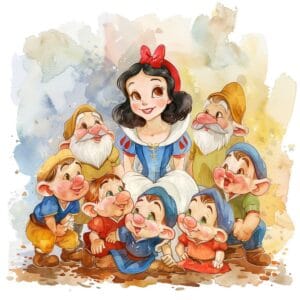
Traditional fairy tales, these are beautiful tales that have been loved by children and their parents for hundreds of years. Perhaps the language has been dusted off a little, but Hansel always steals the gingerbread and Snow White always gets a kiss from the prince. A good ending is also traditional in fairy tales!
Holger Danske
In Denmark there stands an old castle named Kronenburg, close by the Sound of Elsinore, where large ships, both English, Russian, and Prussian, pass by hundreds every day.
Continue readingThe flying trunk
There was once a merchant who was so rich that he could have paved the whole street with gold, and would even then have had enough for a small alley. But he did not do so; he knew the value of money better than to use it in this way.
Continue readingThe hand with the knife
There once lived a girl who had three brothers. The boys meant everything to their mother, and the girl was always put at a disadvantage and treated badly. Every day she had to go out to a barren heath to dig peat, which was used for cooking and heating. A dull old tool was all she had for that nasty work.
Continue readingOld Rinkrank
There was once on a time a King who had a daughter, and he caused a glass mountain to be made, and said that whosoever could cross to the other side of it without falling should have his daughter to wife. Then there was one who loved the King’s daughter, and he asked the King if he might have her. “Yes,” said the King; “if you can cross the mountain without falling, you shall have her.” And the princess said she would go over it with him, and would hold him if he were about to fall. So they set out together to go over it, and when they were half way up the princess slipped and fell, and the glass-mountain opened and shut her up inside it, and her betrothed could not see where she had gone, for the mountain closed immediately. Then he wept and lamented much, and the King was miserable too, and had the mountain broken open where she had been lost, and though the would be able to get her out again, but they could not find the place into which she had fallen. Meanwhile the King’s daughter had fallen quite deep down into the earth into a great cave. An old fellow with a very long gray beard came to meet her, and told her that if she would be his servant and do everything he bade her, she might live, if not he would kill her. So she did all he bade her. In the mornings he took his ladder out of his pocket, and set it up against the mountain and climbed to the top by its help, and then he drew up the ladder after him. The princess had to cook his dinner, make his bed, and do all his work, and when he came home again he always brought with him a heap of gold and silver. When she had lived with him for many years, and had grown quite old, he called her Mother Mansrot, and she had to call him Old Rinkrank. Then once when he was out, and she had made his bed and washed his dishes, she shut the doors and windows all fast, and there was one little window through which the light shone in, and this she left open. When Old Rinkrank came home, he knocked at his door, and cried, “Mother Mansrot, open the door for me.” – “No,” said she, “Old Rinkrank, I will not open the door for thee.” Then he said,
Continue readingEve’s various children
When Adam and Eve were driven out of Paradise, they were compelled to build a house for themselves on unfruitful ground, and eat their bread in the sweat of their brow. Adam dug up the land, and Eve span. Every year Eve brought a child into the world; but the children were unlike each other, some pretty, and some ugly. After a considerable time had gone by, God sent an angel to them, to announce that he was coming to inspect their household. Eve, delighted that the Lord should be so gracious, cleaned her house diligently, decked it with flowers, and strewed reeds on the floor. Then she brought in her children, but only the beautiful ones. She washed and bathed them, combed their hair, put clean raiment on them, and cautioned them to conduct themselves decorously and modestly in the presence of the Lord. They were to bow down before him civilly, hold out their hands, and to answer his questions modestly and sensibly. The ugly children were, however, not to let themselves be seen. One hid himself beneath the hay, another under the roof, a third in the straw, the fourth in the stove, the fifth in the cellar, the sixth under a tub, the seventh beneath the wine-cask, the eighth under an old fur cloak, the ninth and tenth beneath the cloth out of which she always made their clothes, and the eleventh and twelfth under the leather out of which she cut their shoes. She had scarcely got ready, before there was a knock at the house-door. Adam looked through a chink, and saw that it was the Lord. Adam opened the door respectfully, and the Heavenly Father entered. There, in a row, stood the pretty children, and bowed before him, held out their hands, and knelt down. The Lord, however, began to bless them, laid his hands on the first, and said, “Thou shalt be a powerful king;” and to the second, “Thou a prince,” to the third, “Thou a count,” to the fourth, “Thou a knight,” to the fifth, “Thou a nobleman,” to the sixth, “Thou a burgher,” to the seventh, “Thou a merchant,” to the eighth, “Thou a learned man.” He bestowed upon them also all his richest blessings. When Eve saw that the Lord was so mild and gracious, she thought, “I will bring hither my ill-favoured children also, it may be that he will bestow his blessing on them likewise.” So she ran and brought them out of the hay, the straw, the stove, and wherever else she had concealed them. Then came the whole coarse, dirty, shabby, sooty band. The Lord smiled, looked at them all, and said, “I will bless these also.” He laid his hands on the first, and said to him, “Thou shalt be a peasant,” to the second, “Thou a fisherman,” to the third, “Thou a smith,” to the fourth, “Thou a tanner,” to the fifth, “Thou a weaver,” to the sixth, Thou a shoemaker,” to the seventh, “Thou a tailor,” to the eighth, “Thou a potter,” to the ninth, “Thou a waggoner,” to the tenth, “Thou a sailor,” to the eleventh, “Thou an errand-boy,” to the twelfth, “Thou a scullion all the days of thy life.”
When Eve had heard all this she said, “Lord, how unequally thou dividest thy gifts! After all they are all of them my children, whom I have brought into the world, thy favours should be given to all alike.” But God answered, “Eve, thou dost not understand. It is right and necessary that the entire world should be supplied from thy children; if they were all princes and lords, who would grow corn, thresh it, grind and bake it? Who would be blacksmiths, weavers, carpenters, masons, labourers, tailors and seamstresses? Each shall have his own place, so that one shall support the other, and all shall be fed like the limbs of one body.” Then Eve answered, “Ah, Lord, forgive me, I was too quick in speaking to thee. Have thy divine will with my children.”
Lazy Harry
Harry was lazy, and although he had nothing else to do but drive his goat daily to pasture, he nevertheless groaned when he went home after his day’s work was done. “It is indeed a heavy burden,” said he, “and a wearisome employment to drive a goat into the field this way year after year, till late into the autumn! If one could but lie down and sleep, but no, one must have one’s eyes open lest it hurts the young trees, or squeezes itself through the hedge into a garden, or runs away altogether. How can one have any rest, or peace of one’s life?” He seated himself, collected his thoughts, and considered how he could set his shoulders free from this burden. For a long time all thinking was to no purpose, but suddenly it was as if scales fell from his eyes. “I know what I will do,” he cried, “I will marry fat Trina who has also a goat, and can take mine out with hers, and then I shall have no more need to trouble myself.”
So Harry got up, set his weary legs in motion, and went right across the street, for it was no farther, to where the parents of fat Trina lived, and asked for their industrious and virtuous daughter in marriage. The parents did not reflect long. “Birds of a feather, flock together,” they thought, and consented.
The beam
There was once an enchanter who was standing in the midst of a great crowd of people performing his wonders. He had a cock brought in, which lifted a heavy beam and carried it as if it were as light as a feather. But a girl was present who had just found a bit of four-leaved clover, and had thus become so wise that no deception could stand out against her, and she saw that the beam was nothing but a straw. So she cried, “You people, do you not see that it is a straw that the cock is carrying, and no beam?” Immediately the enchantment vanished, and the people saw what it was, and drove the magician away in shame and disgrace. He, however, full of inward anger, said, “I will soon revenge myself?”
After some time the girl’s wedding-day came, and she was decked out, and went in a great procession over the fields to the place where the church was. All at once she came to a stream which was very much swollen, and there was no bridge and no plank to cross it. Then the bride nimbly took her clothes up, and wanted to wade through it. And just as she was thus standing in the water, a man, and it was the enchanter, cried mockingly close beside her, “Aha! Where are thine eyes that thou takest that for water?” Then her eyes were opened, and she saw that she was standing with her clothes lifted up in the middle of a field that was blue with the flowers of blue flax. Then all the people saw it likewise, and chased her away with ridicule and laughter.
The shoes that were danced to pieces
There was once upon a time a King who had twelve daughters, each one more beautiful than the other. They all slept together in one chamber, in which their beds stood side by side, and every night when they were in them the King locked the door, and bolted it. But in the morning when he unlocked the door, he saw that their shoes were worn out with dancing, and no one could find out how that had come to pass. Then the King caused it to be proclaimed that whosoever could discover where they danced at night, should choose one of them for his wife and be King after his death, but that whosoever came forward and had not discovered it within three days and nights, should have forfeited his life. It was not long before a King’s son presented himself, and offered to undertake the enterprise. He was well received, and in the evening was led into a room adjoining the princesses’ sleeping-chamber. His bed was placed there, and he was to observe where they went and danced, and in order that they might do nothing secretly or go away to some other place, the door of their room was left open.
But the eyelids of the prince grew heavy as lead, and he fell asleep, and when he awoke in the morning, all twelve had been to the dance, for their shoes were standing there with holes in the soles. On the second and third nights it fell out just the same, and then his head was struck off without mercy. Many others came after this and undertook the enterprise, but all forfeited their lives. Now it came to pass that a poor soldier, who had a wound, and could serve no longer, found himself on the road to the town where the King lived. There he met an old woman, who asked him where he was going. “I hardly know myself,” answered he, and added in jest, “I had half a mind to discover where the princesses danced their shoes into holes, and thus become King.” – “That is not so difficult,” said the old woman, “you must not drink the wine which will be brought to you at night, and must pretend to be sound asleep.” With that she gave him a little cloak, and said, “If you put on that, you will be invisible, and then you can steal after the twelve.” When the soldier had received this good advice, he went into the thing in earnest, took heart, went to the King, and announced himself as a suitor. He was as well received as the others, and royal garments were put upon him. He was conducted that evening at bed-time into the ante-chamber, and as he was about to go to bed, the eldest came and brought him a cup of wine, but he had tied a sponge under his chin, and let the wine run down into it, without drinking a drop. Then he lay down and when he had lain a while, he began to snore, as if in the deepest sleep. The twelve princesses heard that, and laughed, and the eldest said, “He, too, might as well have saved his life.” With that they got up, opened wardrobes, presses, cupboards, and brought out pretty dresses; dressed themselves before the mirrors, sprang about, and rejoiced at the prospect of the dance. Only the youngest said, “I know not how it is; you are very happy, but I feel very strange; some misfortune is certainly about to befall us.” – “Thou art a goose, who art always frightened,” said the eldest. “Hast thou forgotten how many Kings’ sons have already come here in vain? I had hardly any need to give the soldier a sleeping-draught, in any case the clown would not have awakened.” When they were all ready they looked carefully at the soldier, but he had closed his eyes and did not move or stir, so they felt themselves quite secure. The eldest then went to her bed and tapped it; it immediately sank into the earth, and one after the other they descended through the opening, the eldest going first. The soldier, who had watched everything, tarried no longer, put on his little cloak, and went down last with the youngest. Half-way down the steps, he just trod a little on her dress; she was terrified at that, and cried out, “What is that? who is pulling my dress?” – “Don’t be so silly!” said the eldest, “you have caught it on a nail.” Then they went all the way down, and when they were at the bottom, they were standing in a wonderfully pretty avenue of trees, all the leaves of which were of silver, and shone and glistened. The soldier thought, “I must carry a token away with me,” and broke off a twig from one of them, on which the tree cracked with a loud report. The youngest cried out again. “Something is wrong, did you hear the crack?” But the eldest said, “It is a gun fired for joy, because we have got rid of our prince so quickly.” After that they came into an avenue where all the leaves were of gold, and lastly into a third where they were of bright diamonds; he broke off a twig from each, which made such a crack each time that the youngest started back in terror, but the eldest still maintained that they were salutes. They went on and came to a great lake whereon stood twelve little boats, and in every boat sat a handsome prince, all of whom were waiting for the twelve, and each took one of them with him, but the soldier seated himself by the youngest. Then her prince said, “I can’t tell why the boat is so much heavier to-day; I shall have to row with all my strength, if I am to get it across.” – “What should cause that,” said the youngest, “but the warm weather? I feel very warm too.” On the opposite side of the lake stood a splendid, brightly-lit castle, from whence resounded the joyous music of trumpets and kettle-drums. They rowed over there, entered, and each prince danced with the girl he loved, but the soldier danced with them unseen, and when one of them had a cup of wine in her hand he drank it up, so that the cup was empty when she carried it to her mouth; the youngest was alarmed at this, but the eldest always made her be silent. They danced there till three o’clock in the morning when all the shoes were danced into holes, and they were forced to leave off; the princes rowed them back again over the lake, and this time the soldier seated himself by the eldest. On the shore they took leave of their princes, and promised to return the following night. When they reached the stairs the soldier ran on in front and lay down in his bed, and when the twelve had come up slowly and wearily, he was already snoring so loudly that they could all hear him, and they said, “So far as he is concerned, we are safe.” They took off their beautiful dresses, laid them away, put the worn-out shoes under the bed, and lay down. Next morning the soldier was resolved not to speak, but to watch the wonderful goings on, and again went with them. Then everything was done just as it had been done the first time, and each time they danced until their shoes were worn to pieces. But the third time he took a cup away with him as a token. When the hour had arrived for him to give his answer, he took the three twigs and the cup, and went to the King, but the twelve stood behind the door, and listened for what he was going to say. When the King put the question, “Where have my twelve daughters danced their shoes to pieces in the night?” he answered, “In an underground castle with twelve princes,” and related how it had come to pass, and brought out the tokens. The King then summoned his daughters, and asked them if the soldier had told the truth, and when they saw that they were betrayed, and that falsehood would be of no avail, they were obliged to confess all. Thereupon the King asked which of them he would have to wife? He answered, “I am no longer young, so give me the eldest.” Then the wedding was celebrated on the self-same day, and the kingdom was promised him after the King’s death. But the princes were bewitched for as many days as they had danced nights with the twelve.
The wilful child
Once upon a time there was a child who was willful, and would not dowh at her mother wished. For this reason God had no pleasure in her, and let her become ill, and no doctor could do her any good, and in a short time she lay on her death-bed. When she had been lowered into her grave, and the earth was spread over her, all at once her arm came out again, and stretched upwards, and when they had put it in and spread fresh earth over it, it was all to no purpose, for the arm always came out again. Then the mother herself was obliged to go to the grave, and strike the arm with a rod, and when she had done that, it was drawn in, and then at last the child had rest beneath the ground.
Continue reading